Treasures of the Orient
Tabula Geographica Hydrophylacium Asiae Majoris exhibens - Kircher 1665
Tabula Geographica Hydrophylacium Asiae Majoris exhibens - Kircher 1665
Tabula Geographica Hydrophylacium Asiae Majoris exhibens
Drawn/Published by: Athanasius Kircher
Location: Amsterdam
Year: 1665
From: Mundus Subterraneus (The Subterranean World)
Condition: Hand-coloured copper engraving; professionally framed.
A Visionary Map of Asia’s "Hidden" Waters
This extraordinary 1665 engraving by the Jesuit polymath Athanasius Kircher is a fascinating example of 17th-century "theoretical" geography. Rather than focusing solely on navigation, this map was designed to illustrate Kircher’s radical scientific theory: that the Earth's major rivers were fed by massive, hollow subterranean reservoirs known as Hydrophylacia.
The Great Central Reservoir
The most striking feature of the map is the dark, crater-like mountain range in Central Asia. This is the Hydrophylacium Asiae Majoris, which Kircher believed was a giant water-store located beneath the Himalayas. From this singular source, he traces the origins of Asia’s mightiest rivers—including the Ganges, Indus, and Mekong—showing them flowing through "occult meanders" or hidden tunnels before reaching the surface.
Regional Geography
While the map is primarily a scientific diagram, it captures the broader layout of the East Indies with a unique perspective:
- The Malay Peninsula: The peninsula is clearly defined, stretching south toward the vital maritime corridors that connect the Indian and Pacific Oceans.
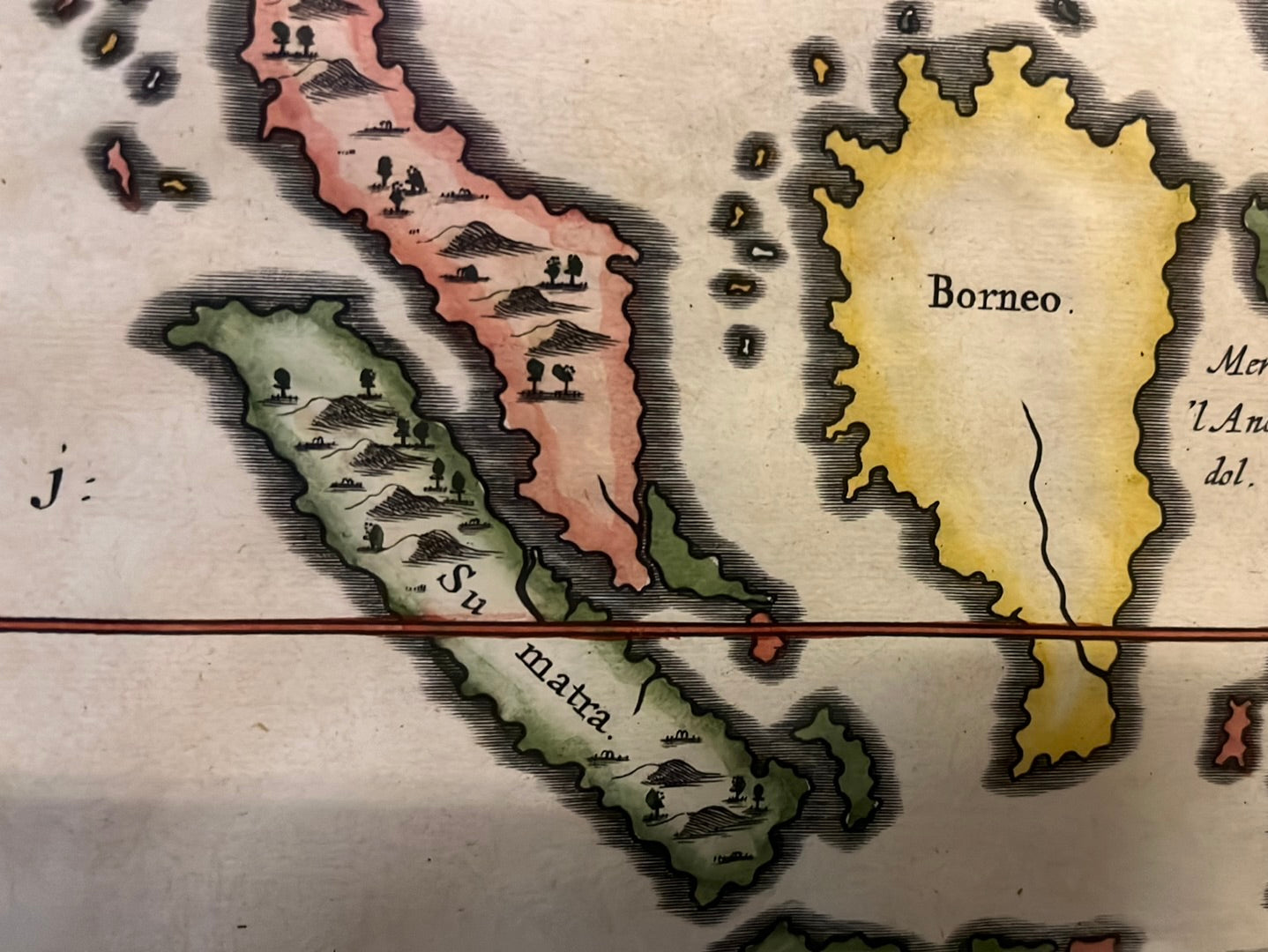
- Islands of the East: The map provides a speculative but recognizable rendering of Sumatra, Borneo, Java, and the Philippines, illustrating how 17th-century scholars integrated burgeoning trade knowledge with their own scientific hypotheses.
A Monument of Baroque Science
Kircher’s works were among the first to attempt a "universal" explanation for the Earth's physical phenomena. This map remains a highly sought-after piece for collectors, representing the era when the boundaries between science, philosophy, and global exploration were beautifully intertwined.